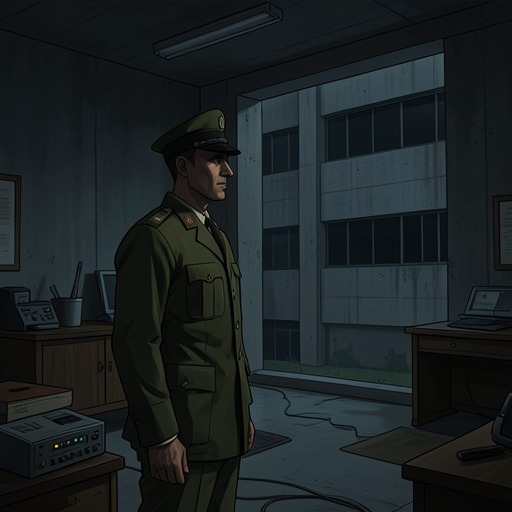
OMGUS
The Zone of InterestOMGUS, identified as the American Office of Military Government, is the postwar institution for which the narrator works as a translator. Its stated program of denazification, demilitarisation, deindustrialisation, decartelisation, and democratisation places it at the center of the novel’s account of occupation and attempted political renewal. Yet the narrator’s work there also exposes a gap between public reform and the difficulty of rebuilding a private moral life.
Identity and Mandate
The novel names OMGUS in connection with the five Ds: denazify, demilitarise, deindustrialise, decartelise, and democratise. The list gives the office a broad role in the postwar reordering of Germany, spanning political change, military restraint, economic restructuring, and democratic government. The text does not detail OMGUS’s internal structure or describe particular programs in operation; its significance here is conveyed through the narrator’s employment and his reflections on the purpose and limits of postwar reform.
Translation Work and the Postwar Office
By the time of the narrator’s September 1948 journey south-east, he is translating for the Americans and says that he quite likes the work. His colleagues are part of the world of OMGUS, where the five Ds also circulate as a pointed joke: their formulation of the new order sits beside a sardonic national refrain that Germans knew nothing about what had happened. The joke makes denial audible within the very milieu charged with denazification. The narrator regards himself as reformed, but says that he cannot construct a self-sufficient inner life. The office’s reforming vocabulary therefore stands in sharp contrast with his unresolved sense of himself after his service in the camp system.
Denazification and Personal Responsibility
The narrator’s work places him within an American-led effort to remake postwar public life, but the novel does not present employment by OMGUS as proof that he has resolved his own responsibility. His account of feeling divided while working in the camp system, and halved afterward, gives the institutional project a personal counterpoint: a change in political order does not, by itself, produce an integrated self. The text’s contrast is not that OMGUS has no purpose, but that administrative reform and inward reckoning are different tasks.
Reparations and Victims’ Justice
Alongside his translation work, the narrator undertakes extracurricular work on reparations guidelines. David Merlin, a Jewish lawyer and captain in the US Army, recruited him for this work a year earlier. The claims concern indemnities for murdered relatives, years lost to slavery and terror, continuing physical and mental debility, and stolen property. The narrator distinguishes this effort from victors’ justice and identifies it instead with justice for victims. The passage does not say that OMGUS administers the reparations work; rather, it places the project beside the narrator’s office employment, showing how postwar service could extend from the language of occupation policy toward concrete claims for those harmed by Nazi rule.